
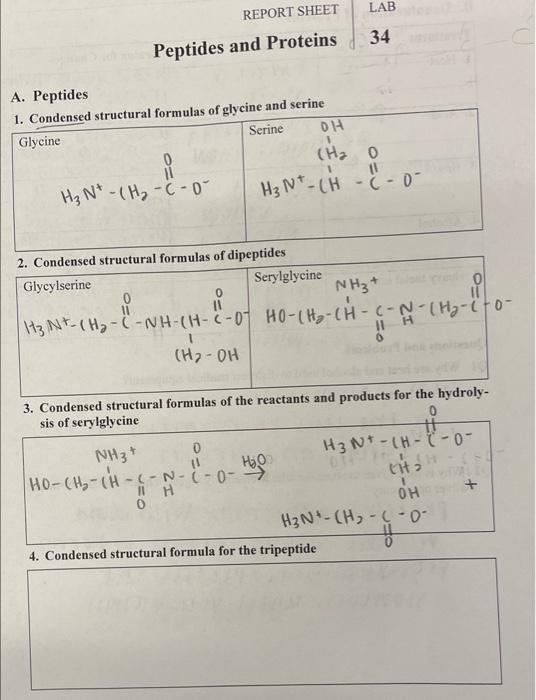
Answer: The condensed structural formulas for the peptides and the hydrolysis reaction are correctly represented in the image.
Explanation: The subject of this problem is Biochemistry, specifically focusing on peptides and proteins. The key concepts involved include the structure of amino acids, peptide bonds, and hydrolysis reactions. The formulas represent the amino acids glycine and serine, their combination to form a dipeptide, and the hydrolysis of that dipeptide into its constituent amino acids.
Steps:
- Identify Amino Acids:
- Glycine: \( \text{NH}_2\text{-CH}_2\text{-COOH} \)
- Serine: \( \text{NH}_2\text{-CH}(\text{OH})\text{-COOH} \)
- Condensed Structural Formulas:
- Glycine: \( \text{H}_2\text{N}^+ - \text{C}(\text{H}_2) - \text{C}(\text{O})^- \)
- Serine: \( \text{H}_2\text{N}^+ - \text{C}(\text{H}) - \text{C}(\text{OH}) - \text{C}(\text{O})^- \)
- Dipeptide Formation:
- Glycylserine: Formed by linking glycine and serine through a peptide bond, resulting in \( \text{H}_2\text{N}^+ - \text{C}(\text{H}_2) - \text{C}(\text{N}) - \text{C}(\text{O})^- \).
- Hydrolysis Reaction:
- The hydrolysis of serylglycine involves the addition of water to break the peptide bond:
\[
\text{H}_2\text{O} + \text{H}_2\text{N}^+ - \text{C}(\text{H}_2) - \text{C}(\text{N}) - \text{C}(\text{O})^- \rightarrow \text{H}_2\text{N}^+ - \text{C}(\text{H}_2) - \text{COOH} + \text{H}_2\text{N}^+ - \text{C}(\text{OH}) - \text{COOH}
\]
- Tripeptide Formation:
- The tripeptide would involve the addition of another amino acid to the dipeptide structure, following similar bonding rules.
This process outlines the formation and breakdown of peptides, emphasizing the importance of peptide bonds and hydrolysis in protein chemistry.