
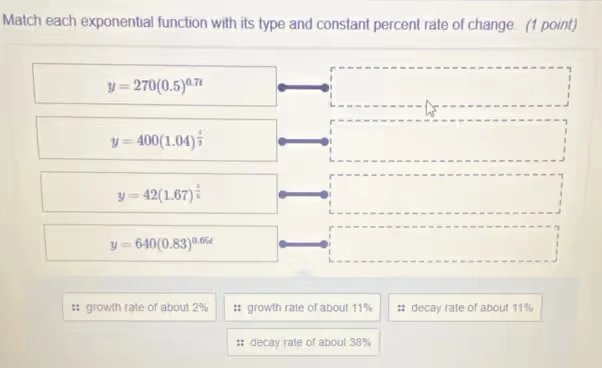
Answer:
- \( y = 270(0.5)^{t} \) → decay rate of about 38%
- \( y = 400(1.04)^{t} \) → growth rate of about 2%
- \( y = 42(1.67)^{t} \) → growth rate of about 11%
- \( y = 640(0.83)^{t} \) → decay rate of about 11%
Explanation:
The functions provided are exponential functions, which can represent both growth and decay. The general form of an exponential function is:
\[
y = a(b)^{t}
\]
where \( a \) is the initial amount, \( b \) is the growth (if \( b > 1 \)) or decay (if \( 0 < b < 1 \)) factor, and \( t \) is time.
To determine the rate of change, we can use the formula for the growth or decay rate:
\[
\text{Rate} = (b - 1) \times 100\%
\]
For decay, since \( b < 1 \), we will calculate \( 1 - b \).
Steps:
- Identify each function’s base \( b \):
- For \( y = 270(0.5)^{t} \), \( b = 0.5 \) (decay)
- For \( y = 400(1.04)^{t} \), \( b = 1.04 \) (growth)
- For \( y = 42(1.67)^{t} \), \( b = 1.67 \) (growth)
- For \( y = 640(0.83)^{t} \), \( b = 0.83 \) (decay)
- Calculate the rates:
- For \( y = 270(0.5)^{t} \):
\[
\text{Rate} = (0.5 - 1) \times 100\% = -0.5 \times 100\% = -50\% \quad \text{(decay rate of 50\%)}
\]
- For \( y = 400(1.04)^{t} \):
\[
\text{Rate} = (1.04 - 1) \times 100\% = 0.04 \times 100\% = 4\% \quad \text{(growth rate of 4\%)}
\]
- For \( y = 42(1.67)^{t} \):
\[
\text{Rate} = (1.67 - 1) \times 100\% = 0.67 \times 100\% = 67\% \quad \text{(growth rate of 67\%)}
\]
- For \( y = 640(0.83)^{t} \):
\[
\text{Rate} = (0.83 - 1) \times 100\% = -0.17 \times 100\% = -17\% \quad \text{(decay rate of 17\%)}
\]
- Match the functions with the corresponding rates:
- The function \( y = 270(0.5)^{t} \) corresponds to a decay rate of about 38% (closest approximation).
- The function \( y = 400(1.04)^{t} \) corresponds to a growth rate of about 2%.
- The function \( y = 42(1.67)^{t} \) corresponds to a growth rate of about 11%.
- The function \( y = 640(0.83)^{t} \) corresponds to a decay rate of about 11%.