
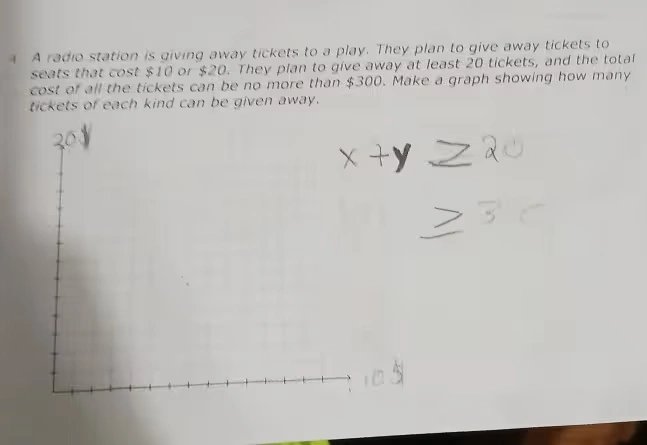
Answer: The graph will show the feasible region defined by the inequalities \( x + y \geq 20 \) and \( 10x + 20y \leq 300 \).
Explanation: This problem involves linear inequalities and graphing in the context of a real-world scenario. We need to determine how many tickets of each type (costing $10 and $20) can be given away while satisfying the conditions on the total number of tickets and their total cost.
Steps:
- Define Variables:
- Let \( x \) be the number of $10 tickets.
- Let \( y \) be the number of $20 tickets.
- Set Up Inequalities:
- From the problem, we have two conditions:
- The total number of tickets must be at least 20:
\[
x + y \geq 20
\]
- The total cost of the tickets must not exceed $300:
\[
10x + 20y \leq 300
\]
- Simplify the Cost Inequality:
- Divide the entire inequality \( 10x + 20y \leq 300 \) by 10:
\[
x + 2y \leq 30
\]
- Graph the Inequalities:
- Graph \( x + y = 20 \):
- When \( x = 0 \), \( y = 20 \) (point (0, 20)).
- When \( y = 0 \), \( x = 20 \) (point (20, 0)).
- Graph \( x + 2y = 30 \):
- When \( x = 0 \), \( y = 15 \) (point (0, 15)).
- When \( y = 0 \), \( x = 30 \) (point (30, 0)).
- Plot these lines on a graph.
- Identify the Feasible Region:
- The area where the two inequalities overlap will be the feasible region. This region will be above the line \( x + y = 20 \) and below the line \( x + 2y = 30 \).
- Determine the Axes:
- The x-axis represents the number of $10 tickets, and the y-axis represents the number of $20 tickets.
- Shade the Feasible Region:
- Shade the area that satisfies both inequalities. This area will show all combinations of \( x \) and \( y \) that meet the conditions.
By following these steps, you can visualize how many tickets of each kind can be given away while adhering to the constraints provided.