
• Home /
  • solutions /
  • Biology /
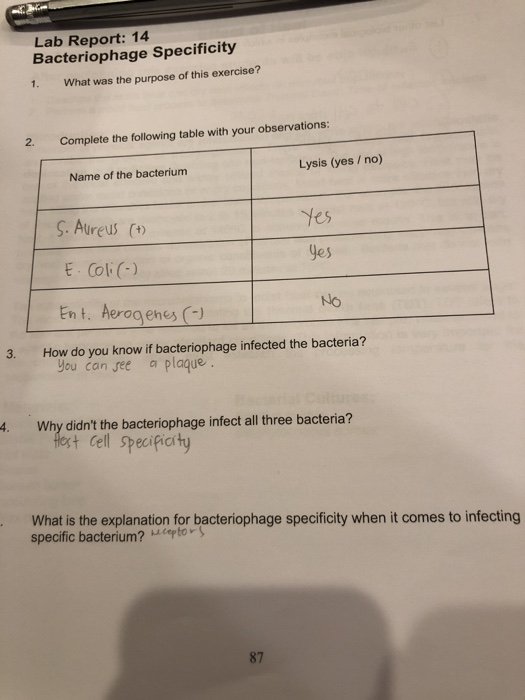
  • Lab Report: 14 Bacteriophage Specificity 1. What was the purpose of this exercise? 2. Complete the following table with your observations: Name of the bacterium Lysis (yes / no) S. Aureus (+) Yes E. Coli (-) Yes Ent. Aerogenes (-) No 3. How do you know if bacteriophage infected the bacteria? You can see a plaque. 4. Why didn’t the bacteriophage infect all three bacteria? Host Cell Specificity What is the explanation for bacteriophage specificity when it comes to infecting specific bacterium? _________________________ 87
Lab Report: 14 Bacteriophage Specificity 1. What was the purpose of this exercise? 2. Complete the following table with your observations: Name of the bacterium Lysis (yes / no) S. Aureus (+) Yes E. Coli (-) Yes Ent. Aerogenes (-) No 3. How do you know if bacteriophage infected the bacteria? You can see a plaque. 4. Why didn't the bacteriophage infect all three bacteria? Host Cell Specificity What is the explanation for bacteriophage specificity when it comes to infecting specific bacterium? _________________________ 87

Lab Report: 14 Bacteriophage Specificity 1. What was the purpose of this exercise? 2. Complete the following table with your observations: Name of the bacterium Lysis (yes / no) S. Aureus (+) Yes E. Coli (-) Yes Ent. Aerogenes (-) No 3. How do you know if bacteriophage infected the bacteria? You can see a plaque. 4. Why didn’t the bacteriophage infect all three bacteria? Host Cell Specificity What is the explanation for bacteriophage specificity when it comes to infecting specific bacterium? _________________________ 87

Answer: The purpose of the exercise is to investigate bacteriophage specificity in infecting different bacteria.

Explanation: This lab report focuses on bacteriophages, which are viruses that specifically infect bacteria. The key concepts involved include lysis (the breaking down of a cell) and host cell specificity, which refers to the ability of a bacteriophage to infect only certain types of bacteria. The observations indicate whether lysis occurred for each bacterium tested.

Steps:

  1. Identify the Bacteria and Lysis Results:
  • S. Aureus (+): Lysis occurred (Yes).
  • E. Coli (-): Lysis occurred (Yes).
  • Ent. Aerogenes (-): No lysis occurred (No).
  1. Determine How to Identify Infection:
  • Infection by the bacteriophage can be identified by the presence of plaques, which are clear zones on a bacterial lawn where bacteria have been lysed.
  1. Explain Why Not All Bacteria Were Infected:
  • The bacteriophage did not infect all three bacteria due to host cell specificity, meaning the bacteriophage can only attach to and penetrate specific bacterial cells based on receptor compatibility.
  1. Further Explanation of Bacteriophage Specificity:
  • Bacteriophages have specific receptors that allow them to attach to certain bacteria. This specificity is determined by the molecular interactions between the phage and the bacterial surface, which can vary significantly among different bacterial species.

This analysis highlights the importance of understanding how bacteriophages interact with their bacterial hosts, which is crucial in fields like microbiology and virology.