
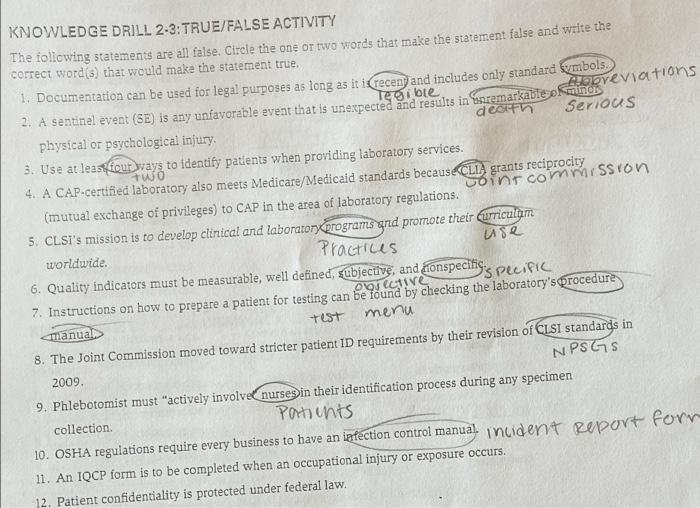
- Answer: Answer: accurate: Documentation can be used for legal purposes if it is recent and includes only standard symbols.
2. A sentinel event (SE) is any unfavorable event that is unexpected and results in unremarkable or minor physical or psychological injury.
Answer: Answer: serious
3. You must use at least four ways to identify patients when providing laboratory services.
Answer: Answer: two
4. A CAP-certified laboratory also meets Medicare/Medicaid standards because CLIA grants reciprocity (mutual exchange of privileges) to CAP in the area of laboratory regulations.
Answer: Answer: accreditation
5. CLIA is a global, for-profit standards developing organization.
Answer: Answer: U.S. federal
6. Quality indicators must be measurable, well defined, subjective, and nonspecific.
Answer: Answer: objective
7. Instructions on how to prepare a patient for testing can be found by checking the laboratory’s procedure manual.
Answer: Answer: test requisition
8. CLSI advises on the need for revisions to the current regulatory standards and the impact proposed revisions will have on patients.
Answer: Answer: laboratories
9. Phlebotomists must “actively involve” nurses in their identification process during any specimen collection.
Answer: Answer: patients
10. OSHA regulations require every business to have an infection control manual.
Answer: Answer: healthcare facility
11. An IQCP form is to be completed when an occupational injury or exposure occurs.
Answer: Answer: a quality control procedure is not followed
12. Patient confidentiality is protected under state law.
Answer: Answer: federal and state
13. The most common civil actions in healthcare are based on criminal law.
Answer: Answer: tort law
14. A minor is anyone who has not reached the age of 18 years.
Answer: Answer: the age of majority
15. The patient’s record is a concise documentation of the medical care given.
Answer: Answer: comprehensive